
[EXHIBITOR_MANUAL]
Nobody reads the
forty-page PDF.
The exhibitor manual is the document every organiser sends and almost no exhibitor finishes — one static file covering every rule for every stand type, with the three paragraphs that actually apply to a given exhibitor buried somewhere past page twelve. This turns it into a portal instead.
Adapted per exhibitor type Task tracking with deadlines Six portal languages
The failure mode
A PDF sent to five hundred exhibitors is a broadcast, not a record. It cannot tell you who opened it, who understood it, or who is about to miss a deadline it contains.
Every exhibitor gets the same document regardless of stand type, so the food vendor wades through drone-permit rules to find the one paragraph about power points. Most give up before they reach it, and the organiser finds out at bump-in.
Adaptive by design
Show each exhibitor their own manual.
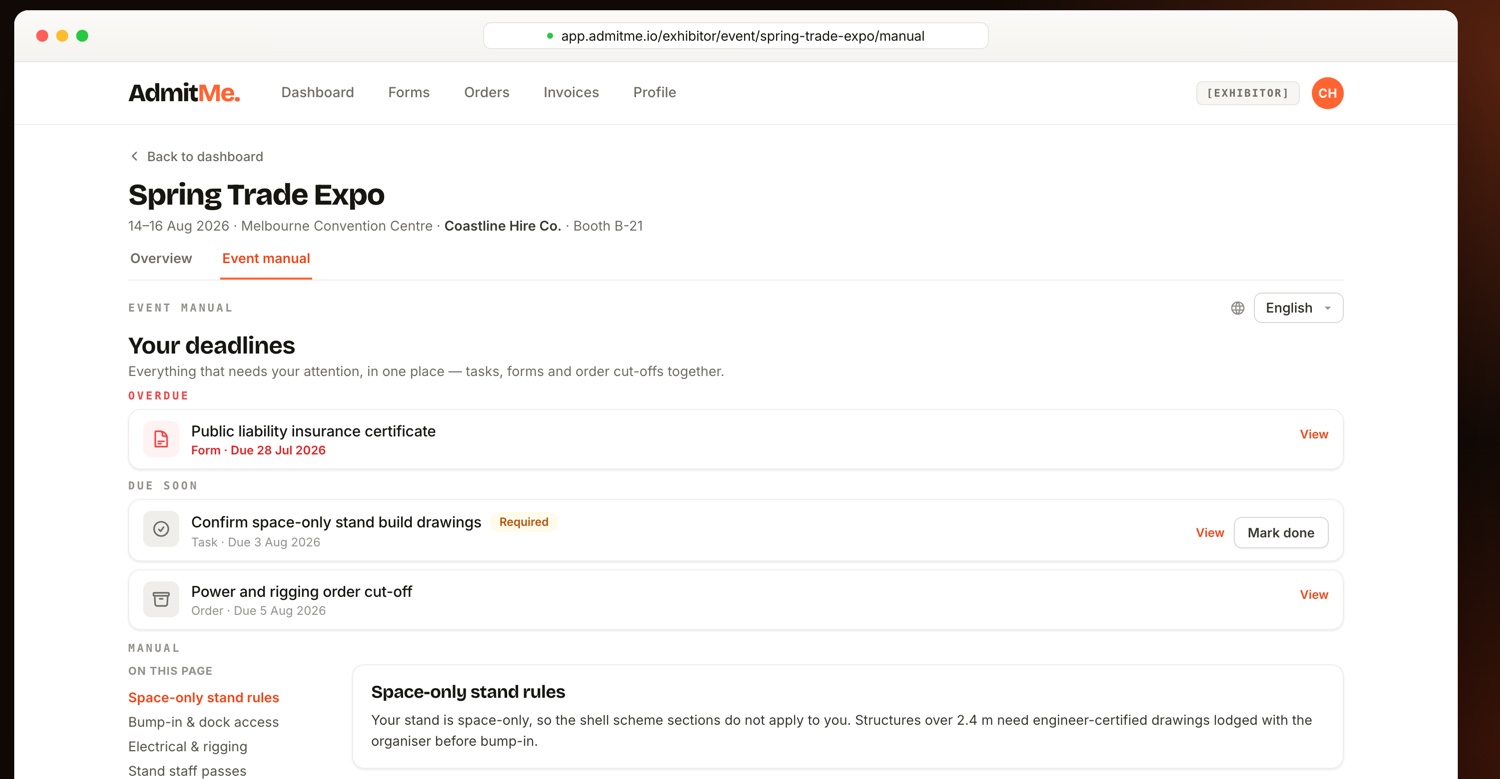
The portal reads the same registration data the forms and connector system already use, and shows only what applies. A shell-scheme exhibitor never sees the space-only-build rules; a food vendor sees the catering compliance section before anything about fascia signage.
Content adapted per exhibitor type
Sections, requirements and deadlines are scoped to what an exhibitor actually registered for — stand type, hall, and add-ons — instead of one document trying to cover every case at once.
Conditional display, driven by registration data
Answering "yes" to a question can reveal the next section that applies — a drone permit prompt only appears for exhibitors who said they are flying one, the way the form builder already handles conditional fields.
Tasks, not paragraphs
Every required action is a task, with an owner.
A manual describes what needs to happen. A task list tracks whether it did. Every required action — a form to submit, a payment to make, a document to upload — is a task with an assignee and a status, so the exhibitor sees a checklist instead of a wall of text, and the organiser sees who is actually behind.
- Assignment and tracking. Tasks can be assigned to a named contact at the exhibitor, so the organiser knows who to chase rather than which company.
- A deadline on everything. Every required action shows its due date next to it — not in an appendix nobody cross-references.
- Status the organiser can see. Complete, in progress or overdue, rolled up per exhibitor and across the whole event.
Multilingual
The portal reads their language.
International exhibitor lists are common at trade shows and expos. The exhibitor portal is available in six languages; the organiser dashboard stays English, so your team works in one language while exhibitors read in theirs.
An exhibitor sets their own language from the portal; nothing an organiser configures changes. The organiser-side dashboard, review queue and reminder schedule stay in English regardless of which languages the floor is reading in.
Replace the PDF on your next show.
The exhibitor manual is part of exhibitor management, not a separate purchase. 28 days free, or until the day after your first event, up to 90 days. No card.